
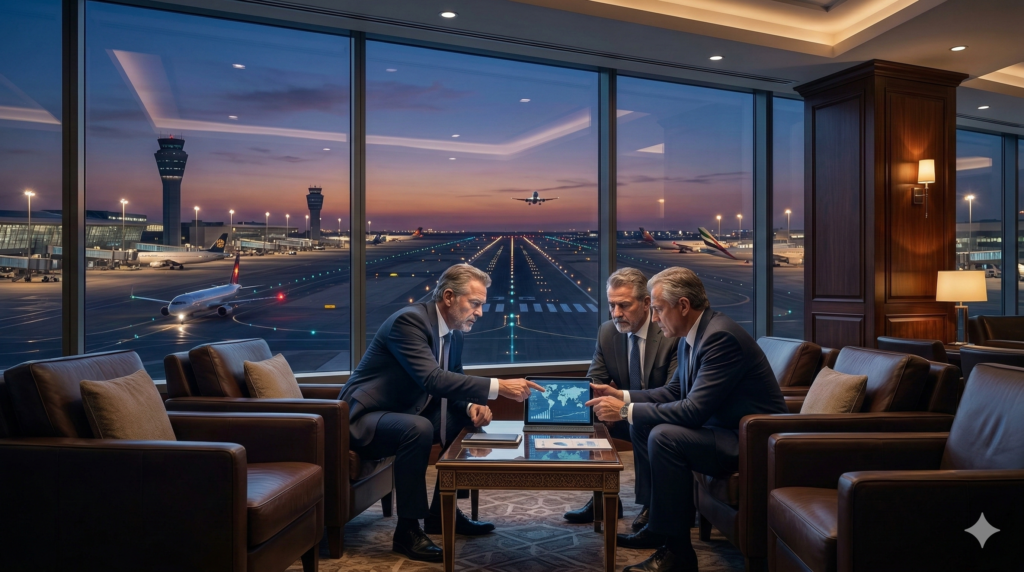
In recent months, spontaneous Middle East airspace closures and geopolitical shifts have caused unprecedented spikes in delayed or canceled C-suite travel, leaving critical corporate decisions paralyzed in transit. Relying on “fly-in, fly-out” executives to manage Gulf operations is no longer just an inconvenience; it is a massive organizational liability. When your decision-makers are grounded in London or Singapore, your regional competitors are already moving ahead.
The Operational Cost of Executive Travel Disruptions in the UAE
Historically, many multinationals treated Dubai as a satellite office managed by visiting directors. However, executive travel disruptions in the UAE are forcing a rapid strategic pivot. When board members are repeatedly delayed, contract signings stall, employee morale wavers, and compliance issues sit unresolved.
Transitioning to a Localized Executive Team GCC
To guarantee business continuity, organizations must shift from commuter leadership to planting deep, senior-level roots within the region. Building a localized executive team GCC is the only sustainable way to ensure your company remains agile during global logistical crises.
Critical advantages of localized leadership:
Immediate, on-the-ground crisis management without waiting for time-zone alignment or flight clearances.
Deeper relationship-building with key stakeholders and government entities in the region.
Enhanced employee retention, as local teams feel supported by visible, accessible leadership.
26 Years of Insight: The Era of the "Suitcase CEO" is Over
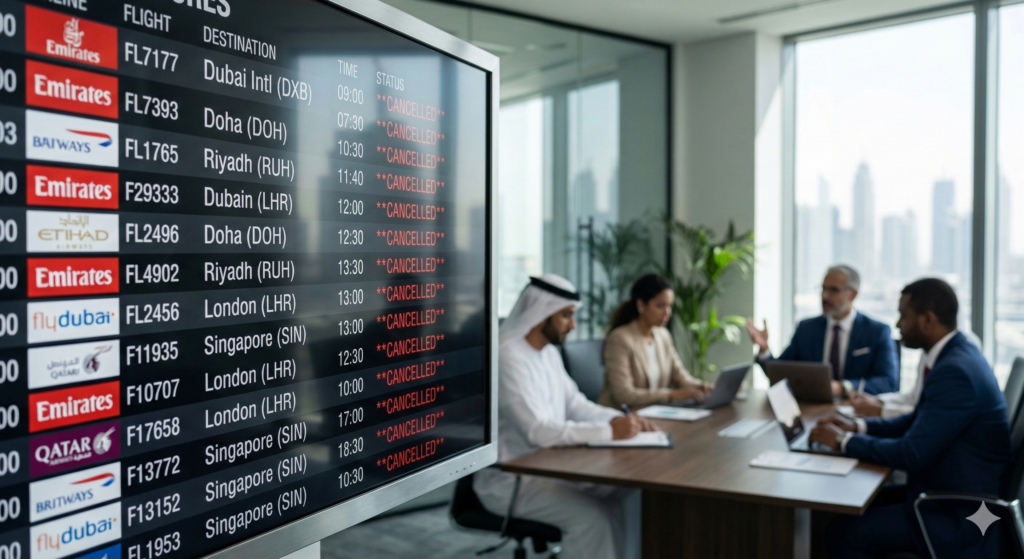
Over the last two and a half decades of managing human capital across the Gulf, the most profound shift I have witnessed is the death of the “Suitcase CEO.” Years ago, it was a status symbol to have your regional director flying first-class into Riyadh every other week; today, it is a glaring vulnerability. I have seen multi-million dollar deals in Saudi Arabia collapse simply because a foreign-based executive missed a crucial face-to-face meeting due to a sudden airspace restriction. The KSA and UAE markets move at breakneck speed. If your leadership team is not physically breathing the same air as your regional workforce, you are effectively running your company on a time delay. True market dominance now requires senior leaders who live in the community, understand the local pulse, and can pivot strategies the moment the ground shifts.
Conclusion
Geopolitical unpredictability and airspace closures have fundamentally changed how companies must operate in the Middle East. Transitioning from commuter executives to a fully empowered, localized leadership team is the definitive strategy to secure your operations, protect your bottom line, and outpace the competition.
About the Author
“As an HR Manager and the visionary behind PulseMina HCM, our founder brings 26 years of extensive HR leadership experience spanning the UAE and KSA. Their expertise lies in talent strategy, organizational scaling, and navigating complex Middle Eastern labor regulations for modern enterprises.”
Are your HR systems equipped to transition your leadership structure smoothly?
Managing executive compensation, regional onboarding, and cross-border compliance requires an agile technological backbone. Empower your newly localized leadership with PulseMina HCM. Book a demo today and ensure your human capital strategy is as resilient as your business!